
VoIP vs Voice Termination: Key Differences

August 14, 2026
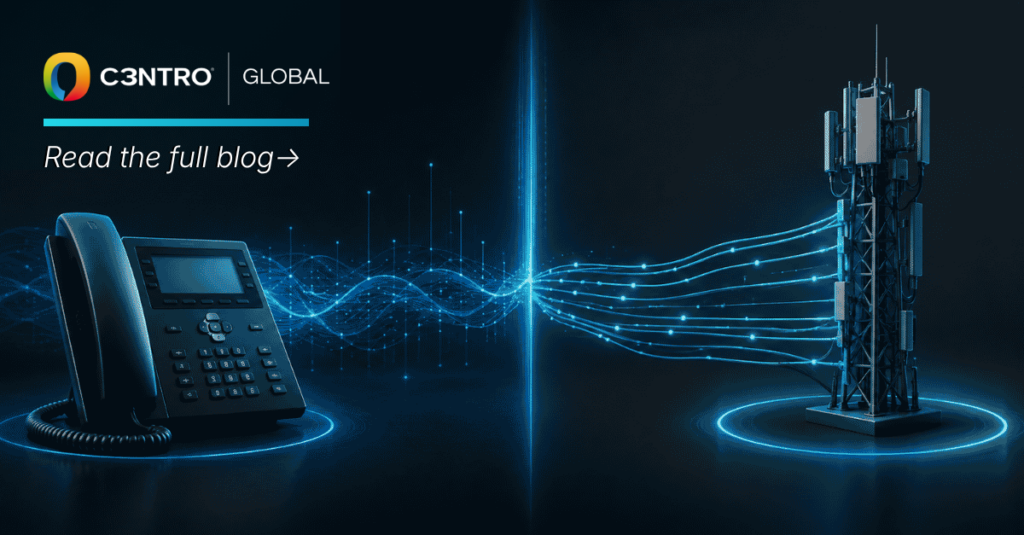
VoIP and voice termination are two terms that appear constantly in enterprise and wholesale voice conversations, often used as if they were interchangeable. They are not. VoIP is a technology. Voice termination is a service. Understanding how they relate, and where one ends and the other begins, is foundational for any operator, CPaaS platform, or enterprise building or evaluating voice infrastructure. According to Mordor Intelligence, VoIP now accounts for 71.72% of wholesale traffic in 2025, with circuit-switched infrastructure being retired on a defined schedule. That shift makes the distinction between the technology layer and the service layer more operationally relevant than ever.
What is VoIP?
VoIP (Voice over Internet Protocol) is the technology framework that converts voice audio into digital packets and transmits them over IP networks. Instead of a dedicated circuit per call, voice data travels as packets sharing network capacity with other traffic, then reassembles at the destination. VoIP is the underlying technology that makes modern voice infrastructure possible, from a softphone on a laptop to a cloud contact center handling thousands of simultaneous calls.
VoIP covers everything inside the IP network. SIP (Session Initiation Protocol) handles call setup, routing, and session management within a VoIP environment. The protocols that carry the actual audio are RTP (Real-time Transport Protocol) and its secure variant SRTP. Codecs such as G.711, G.729, and Opus determine how audio is compressed and transmitted, directly affecting call quality and bandwidth consumption.
What VoIP does not cover by itself is what happens when a call needs to leave the IP network and reach a phone on the public telephone network. That is where voice termination enters the picture.
What Voice Termination Is
Voice termination is the carrier service that delivers a call from an IP network to its destination on the public telephone network (PSTN) or a mobile network. It is the last mile of a voice call, responsible for completing it on the recipient’s network. Every outbound call placed from a VoIP system eventually needs to reach a real phone somewhere, and the operator or carrier that carries it that final stretch is providing termination.
Termination is a commercial service, not a technology. It is priced per minute against a rate deck per destination, bought and sold between carriers. Its quality is determined by the depth and directness of the carrier’s interconnect agreements in each market. According to Mordor Intelligence, the wholesale voice carrier market stands at $44.53 billion in 2026, growing toward $73.63 billion by 2031, with termination accounting for nearly half of that revenue.
Where VoIP Ends and Termination Begins
The boundary between VoIP and voice termination is the point where a call leaves your IP infrastructure and enters the carrier network heading for the PSTN or a mobile operator.
A useful way to think about it: VoIP is the road your call travels inside your own network. Voice termination is the service that carries it the rest of the way to the destination. Everything before the SBC is VoIP infrastructure. Everything after it, from the carrier handoff to the moment the destination phone rings, is termination.
VoIP vs. Voice Termination: Direct Comparison
| Dimension | VoIP | Voice Termination |
|---|---|---|
| What it is | A technology framework for transmitting voice over IP networks | A carrier service that delivers calls to the PSTN or mobile network |
| Where it operates | Inside IP infrastructure: PBX, softphone, cloud platform | Between the carrier and the destination phone network |
| Key protocols | SIP, RTP, SRTP, WebRTC | SIP trunking, carrier handoff at the SBC |
| Pricing model | Per seat, per channel, or platform subscription | Per minute, per destination, against a carrier rate deck |
| Who provides it | UCaaS platforms, VoIP software vendors, PBX providers | Wholesale carriers with direct PSTN interconnects |
| Quality variables | Codec selection, jitter, packet loss, network latency | Route depth, ASR, MOS, carrier interconnect quality per destination |
| Scales with | Number of users, concurrent sessions, software licenses | Concurrent channels on the SIP trunk, per-destination volume |
SIP Termination: Where VoIP and Voice Termination Overlap
SIP termination is the most common point of intersection between VoIP and voice termination in modern deployments. It refers specifically to using the SIP protocol to route outbound VoIP calls from an enterprise or platform through a carrier’s network to the PSTN. SIP termination providers act as a bridge between a VoIP system and the PSTN, enabling outbound calls to landlines, mobile phones, or international numbers.
In practical terms: your VoIP infrastructure handles everything internal. Your SIP termination provider handles everything external. The SIP trunk is the connection between them. The quality of the termination carrier determines what the person on the other end of the call actually experiences. That quality is measured through ASR, MOS, PDD, and route depth per destination.
For a full technical breakdown of how voice termination works at the carrier level, including rate deck structure, quality metrics, and routing decisions, see What Is Voice Termination?
Why the Distinction Matters Operationally
Confusing VoIP with voice termination creates a specific and common operational mistake: diagnosing a termination problem as a VoIP problem, or vice versa. When calls are not completing, or audio quality is degraded, or certain destinations are failing, the cause is almost always in one of two places: the VoIP infrastructure or the termination route. Knowing which is which determines where to look.
Monitoring both layers independently, VoIP quality metrics and termination quality metrics, is the operational standard for voice infrastructure that maintains high performance across markets. For context on how C3ntro Global manages this at the international carrier level, see How C3ntro Global Supports International Voice Operators.
SIP Termination: Where VoIP and Voice Termination Overlap
SIP Termination: Where VoIP and Voice Termination Overlap
Frequently Asked Questions
What is the difference between VoIP and voice termination?
VoIP (Voice over Internet Protocol) is the technology that transmits voice calls as digital packets over IP networks. Voice termination is the carrier service that delivers those calls from the IP network to their destination on the public telephone network or a mobile network. VoIP handles everything inside your infrastructure. Termination handles everything from the carrier handoff outward. Every outbound VoIP call requires termination to reach a phone that is not on the same IP network, which is why the two are inseparable in practice but distinct in function.
What is SIP termination?
SIP termination is the use of the Session Initiation Protocol to route outbound VoIP calls through a carrier’s network to the PSTN. It is the most common technical mechanism connecting a VoIP system to the public telephone network. A SIP termination provider supplies the carrier infrastructure and interconnect agreements that make it possible for a VoIP call to reach any phone in the world. The quality of SIP termination depends on the depth and directness of the carrier’s interconnect relationships per destination, measured through ASR, MOS, and PDD.
What is an SBC in voice infrastructure?
An SBC (Session Border Controller) is the network element that sits at the boundary between a VoIP system and an external carrier network. It handles security enforcement, protocol translation, codec negotiation, and the technical handoff of calls from the IP environment to the termination carrier. The SBC is the physical and logical dividing line between VoIP and voice termination: everything before it is internal VoIP infrastructure, everything after it is carrier termination services.
Can you have VoIP without voice termination?
Yes, for internal communications only. An organization using VoIP for calls between its own employees, where all endpoints are on the same IP network, does not need voice termination. The moment any call needs to reach a phone outside the VoIP network, whether a mobile, a landline, or any number on the PSTN, termination is required. In enterprise and wholesale contexts, virtually all VoIP deployments include termination because internal-only calling scenarios are rare in commercial operations.
What affects voice termination quality?
Voice termination quality is determined by four primary variables: ASR (the percentage of calls that complete successfully), MOS (the perceived audio quality score), PDD (the delay between dialing and ringing), and packet loss on the carrier network. These metrics are route-specific and destination-specific, meaning a carrier may perform excellently to one country and poorly to another depending on the depth of its direct interconnect agreements in each market. Real-time monitoring of these metrics per route, with automatic rerouting when thresholds are breached, is the operational standard for wholesale voice at scale.
RECENT ARTICLES
- PSTN Replacement and Copper Switch-Off September 28, 2026
- Wholesale DIDs: The Complete Guide September 2, 2026
- What Is PSTN Replacement? August 26, 2026
- VoIP vs Voice Termination: Key Differences August 14, 2026
- SMS Delivery Monitoring and Control August 12, 2026
CATEGORIES
INSIGHTS
From the Network





©2026 C3NTRO Telecom All Rights Reserved