what-sms aggregator-is-actually-doing-cover

What Your SMS Aggregator Is Actually Doing

Most platforms treat SMS like a utility. You plug it in, messages go out, users receive them. Except that is not how it works at all. Behind every message that arrives on time, there is an infrastructure chain that most teams never see until something breaks.

This is that chain, explained.

Table of Contents

The Network Behind the Message

Mobile carrier networks are not a single unified system. They are hundreds of independent operators, each with their own rules and filtering logic. A message does not travel in a straight line. It moves through handoffs, each one introducing variables that affect delivery speed and reliability.

An SMS aggregator is the layer that manages those handoffs. It holds direct carrier relationships, routing intelligence, and fallback architecture so platforms do not have to build any of that themselves.

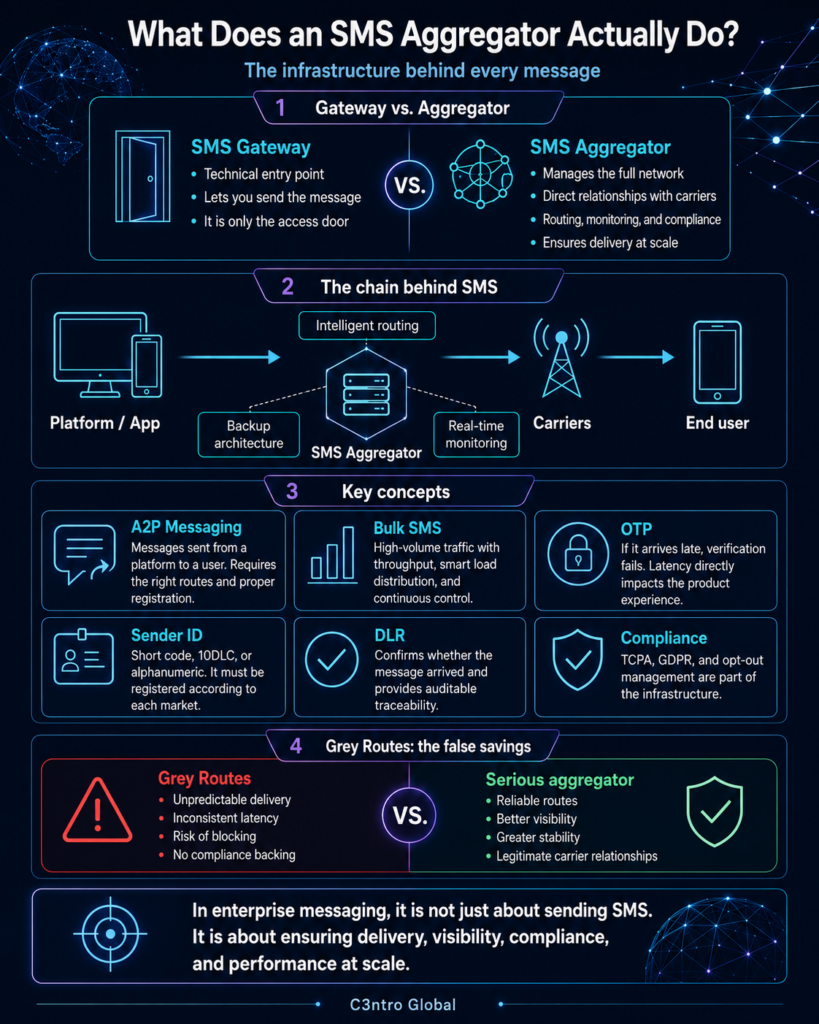
Gateway vs. Aggregator: Not the Same Thing

These two terms get used interchangeably. They should not.

  • SMS gateway: the technical entry point. The door through which a message is submitted into the network.
  • SMS aggregator: the entire system behind that door. Carrier relationships, routing logic, delivery monitoring, compliance infrastructure.

Connecting to a gateway means having a sending mechanism. Connecting to a quality aggregator means having a network.

A2P Messaging and Why It Changes Everything

The industry divides all SMS traffic into two types:

  • P2P (Person-to-Person): conversational messaging between individuals.
  • A2P (Application-to-Person): every message a platform sends to a user. Notifications, codes, alerts, confirmations.

A2P traffic carries different regulatory requirements and different carrier treatment. Platforms that route A2P volume through channels not built for it face filtering, delivery failures, and compliance risk. A good aggregator ensures A2P traffic moves on the right routes, registered correctly, in every market it touches.

Bulk SMS: Where Infrastructure Shows Its Quality

Sending one message is easy. Sending half a million within a narrow time window is an infrastructure problem.

What makes bulk SMS work at scale:

  • Throughput (TPS): how many messages the system processes per second without queuing.
  • Routing distribution: load spread intelligently across carrier connections.
  • Real-time monitoring: degraded routes trigger automatic rerouting before failures accumulate.

Bulk SMS done well is invisible. Bulk SMS done poorly becomes a support ticket.

OTP: The Message That Cannot Be Late

A one-time password has an expiration window. A user is mid-flow, waiting. If the message takes too long, the session times out and the code is worthless.

Flash calls, brief incoming calls where the application reads the call numbAt scale, OTP delivery rate is not a messaging metric. It is a product metric. A drop in successful verifications is one of the fastest indicators of an infrastructure problem underneath.

Sender ID: More Than a Display Name

Every SMS arrives with a sender identifier. Three formats exist:

  • Short code: 5-6 digit number built for high-volume A2P traffic.
  • Long code / 10DLC: standard 10-digit number, requires campaign registration in the US.
  • Alphanumeric sender ID: a brand name instead of a number, not available in every market.

In most regulated markets, unregistered sender identities get filtered or blocked. Managing registration across multiple markets is one of the core responsibilities of a serious aggregator.

Grey Routes: The Risk That Looks Like a Discount

Grey routes move messages through unofficial paths by misrepresenting traffic type, bypassing carrier agreements. They appear cheaper. What they actually produce:

  • Unpredictable delivery rates
  • Inconsistent latency
  • No compliance standing
  • Exposure to carrier blocking at any moment

A reputable aggregator does not use grey routes. Its carrier relationships make them unnecessary.

Delivery Receipts and the Audit Trail

A delivery receipt (DLR) is the carrier’s confirmation that a message reached a device. Without DLRs, a platform has no visibility into what actually happened after a send. Failures only surface when a user reports them.

With full DLR coverage, failures surface immediately, routing adjusts automatically, and every message has an auditable record. For regulated operations, that record is not optional.

Compliance Is Part of the Infrastructure

Every message exists within a regulatory context. Key frameworks to know:

  • TCPA (US): requires prior express written consent for marketing messages.
  • GDPR (EU): governs how phone numbers and consent records are stored and managed.
  • Opt-out handling: STOP requests must be processed and maintained in suppression lists.

The aggregator manages the technical layer. The platform is responsible for consent collection. Both sides have to hold.

The Infrastructure Behind Every Message

Seamless delivery is not accidental. It is routing decisions made in milliseconds, carrier relationships built over years, and monitoring running continuously in the background.

At C3ntro Global, this is the infrastructure we operate. Built for platforms that understand what is actually at stake when a message needs to arrive.

image-sms aggregator-infographic

FAQs

What is an SMS aggregator?

An SMS aggregator is a company that connects platforms and businesses to multiple mobile carrier networks through a single integration. It manages routing, delivery, compliance, and carrier relationships so platforms can send messages at scale without building that infrastructure themselves.

What is the difference between an SMS gateway and an SMS aggregator?

An SMS gateway is the technical entry point through which messages are submitted into a carrier network. An SMS aggregator is the full system behind it: carrier connections, routing logic, fallback architecture, and delivery monitoring. A gateway sends. An aggregator ensures delivery.

What is A2P messaging?

A2P stands for Application-to-Person. It refers to any message sent from a software platform to an end user, including OTP codes, transaction alerts, fraud notifications, and bulk SMS campaigns. A2P traffic is regulated differently from personal messaging and requires specific routing and sender registration.

What is bulk SMS and how does it work?

Bulk SMS is the simultaneous sending of large volumes of messages to many recipients. It requires high throughput capacity, intelligent routing distribution across carrier connections, and real-time delivery monitoring to maintain performance at scale.
what-sms aggregator-is-actually-doing-cover
SMS

SMS Aggregator Glossary

Routing, delivery, OTP, bulk messaging, sender IDs. This is how an SMS aggregator actually works, term by term. The definitive guide by C3ntro Global.

Read More
SMS

SMS OTP delivery infrastructure

Why OTP delivery places unique demands on SMS infrastructure and how latency and routing decisions directly affect authentication completion rates.

Read More
Voice_1
Voice

Wholesale Voice Evolution Telecom

The wholesale voice industry has undergone a complete technical transformation over the past three decades.

Read More
SMS

A2P SMS wholesale telecom

SMS | Wholesale Messaging How A2P SMS Works in Wholesale Telecom Linkedin Instagram Facebook Every SMS message sent by a business, from a transaction alert to an appointment reminder to...


Read More

We are C3ntro

Stay

Connected

©2025  C3NTRO Telecom All Rights Reserved